Texas update — May 2026:
Wortham med-spa owner & ex-medical director surrendered last week on felony charges (Jenifer Cleveland case).
§169.25 + HB 3749 are now enforced.
Read what changed →
For Texas med-spas, IV clinics & aesthetic dermatology
Texas med spas don't have a compliance problem. They have a proof problem.
ProofOps Medical is the AI evidence assistant for Texas med spas and IV clinics. We centralize
staff credentials, Good Faith Exam evidence, medical-director documents, product sourcing,
waste/sharps records, and missing-document follow-ups into a single audit-ready file —
surfaced before a patient complaint, an insurance renewal, a medical-director review, or
an inspection notice turns into an emergency.
All vendor manifests current · 1 GFE pending owner review
Inspection-ready · May 2026
$165,514
Max OSHA willful BBP fine, 2026
39
TMB charges filed in Wortham case
§169.25
New TX rule, effective Jan 9, 2025
HB 3749
Jenifer's Law, effective Sep 1, 2025
Built for §169.25 + HB 3749OSHA 1910.1030 BBP standardHIPAA-ready onboarding (BAA before PHI)Stericycle & MedPro vendor syncAesthetic Record & Boulevard EMRBilingual EN / ES staff workflowsTMB / TDLR / BON license pollingBuilt for §169.25 + HB 3749OSHA 1910.1030 BBP standardHIPAA-ready onboarding (BAA before PHI)Stericycle & MedPro vendor syncAesthetic Record & Boulevard EMRBilingual EN / ES staff workflowsTMB / TDLR / BON license polling
The Texas reality, May 2026
The paper trail is now the difference between control and panic.
Two regulatory shifts and a string of high-profile enforcement events have raised the bar on documentation
for Texas med spas and IV clinics. Documentation gaps are increasingly what turn routine reviews,
complaints, and renewals into high-stress events. Owners who were "fine last year" report different
expectations in 2026.
Tap any story below for the full article and sources.
Why proof, not policy
Most clinics don't have a compliance problem. They have a proof problem.
You almost certainly have a waste collector. A training provider. A medical director. Written procedures somewhere.
The trouble is that the proof sits across paper binders, vendor portals, the front-desk inbox, the owner's
phone, three spreadsheets, and someone's Drive folder. When TMB knocks or your insurer asks at renewal,
you can't produce it in 24 hours.
ProofOps Medical does one thing: it pulls every piece of compliance proof your clinic generates into a single
digital file, keeps it current with AI agents that chase the gaps, and hands you an inspection-ready PDF every
month. The work you already do, finally legible to an inspector.
What ProofOps does
Ten capabilities. One audit-ready file.
Each capability addresses a documentation gap that has shown up in real Texas inspections, insurance audits,
or board complaints in the last twelve months. Most are uncontested in the small-clinic segment.
Stericycle manifests, MedPro pickup receipts, training certificates, SDS sheets, BAA confirmations — auto-CC'd
to one address. Our agent reads each PDF, classifies it (manifest / cert / SDS / invoice / BAA), files it under
the right tag with date, vendor, and license number extracted, and updates your readiness score. Your staff
touches nothing.
02 / Voice AI Vendor CallsVoice AI
When a receipt is missing, the agent calls the vendor for you.
Stericycle pickup three days late? The agent dials their 800 number, navigates the IVR, requests the manifest,
logs the call recording, files the result. The same workflow handles MedPro Disposal, your training provider,
and state license renewal portals. Your front desk stops chasing paperwork for vendors that should be sending it.
03 / Mock Documentation DrillVoice walk-through
Inspector-style documentation drill, on demand.
Click "Run the drill." A voice walk-through poses inspector-style documentation questions drawn from
§169.25, HB 3749, and OSHA 1910.1030 — the same families of records carriers, boards, and inspectors
ask about — for 15–25 minutes, then surfaces a gap report, a recording your medical director can
review, and a checklist of what to organize next. Not a prediction of how any specific TMB inspector
will conduct an actual inspection.
04 / Good Faith Exam TrackerEMR-aware
Surfaces scheduled treatments where GFE documentation appears missing.
ProofOps reads from Aesthetic Record, Boulevard, Symplast, or PatientNow. Any patient on the schedule
for an injectable, IV, laser, or other delegated procedure is checked against the GFE record on file
using the rules your clinic has configured for §169.25. If the documented exam is missing, expired,
or appears non-compliant with those rules, the agent SMS-flags the medical director and the front desk
before the appointment, and adds the chart to the owner's review queue. The clinical decision to
proceed with treatment remains with the licensed provider.
05 / Bilingual Staff WorkflowsEN / ES
Reminders, training prompts, and incident intake — in Spanish.
A meaningful share of Texas clinic staff — front desk, MAs, estheticians — speak Spanish as a first language.
ProofOps' SMS and voice agents are fluent in both. Training renewals, BBP acknowledgments, incident reports,
and owner escalations are delivered in the language each staffer chose at onboarding. Compliance you'll
actually get done.
ProofOps continuously polls TMB, the Texas Board of Nursing, and TDLR for every named staffer.
NP license expiring in 60 days? CPR cert lapsing in 30? Medical director's DEA renewing next quarter?
The agent escalates to the staffer, then to the owner if it isn't resolved. No more discovery during an
audit that someone's been out of license for six months.
07 / Insurance Renewal PackOne click
The PDF every underwriter asks for, ready in seconds.
Your malpractice carrier wants proof at renewal. Click once. ProofOps assembles a single, branded PDF
containing: training certificates, BBP exposure-control plan + last review date, manifest log, sharps
container records, incident log, ECP review, license copies, BAA list, and last twelve months of
readiness scores. Renewals stop being a four-week scramble.
08 / Pre-Inspection War RoomLive
TMB just notified you. You have 48 hours.
Hit the "Inspection notice" button. ProofOps runs a complete gap scan, generates a four-page briefing
for staff (front desk script, RN script, medical director script), drafts replies to anticipated findings,
and surfaces every document the inspector is most likely to request — based on what TMB is currently
citing. Done in ten minutes.
09 / Medical Director Evidence VaultAll plans
If your medical director asks for proof tomorrow, it's already organized.
A dedicated section of your binder holds the medical director agreement, written delegation orders,
standing protocols, supervision arrangement, emergency contact method, periodic review dates,
and signed staff acknowledgments — each item dated, versioned, and linked to the named clinician
it covers. The information your medical director, your insurance carrier, and the TMB ask for first
lives in one place that anyone with access can produce in minutes.
10 / Private Readiness DashboardInternal use
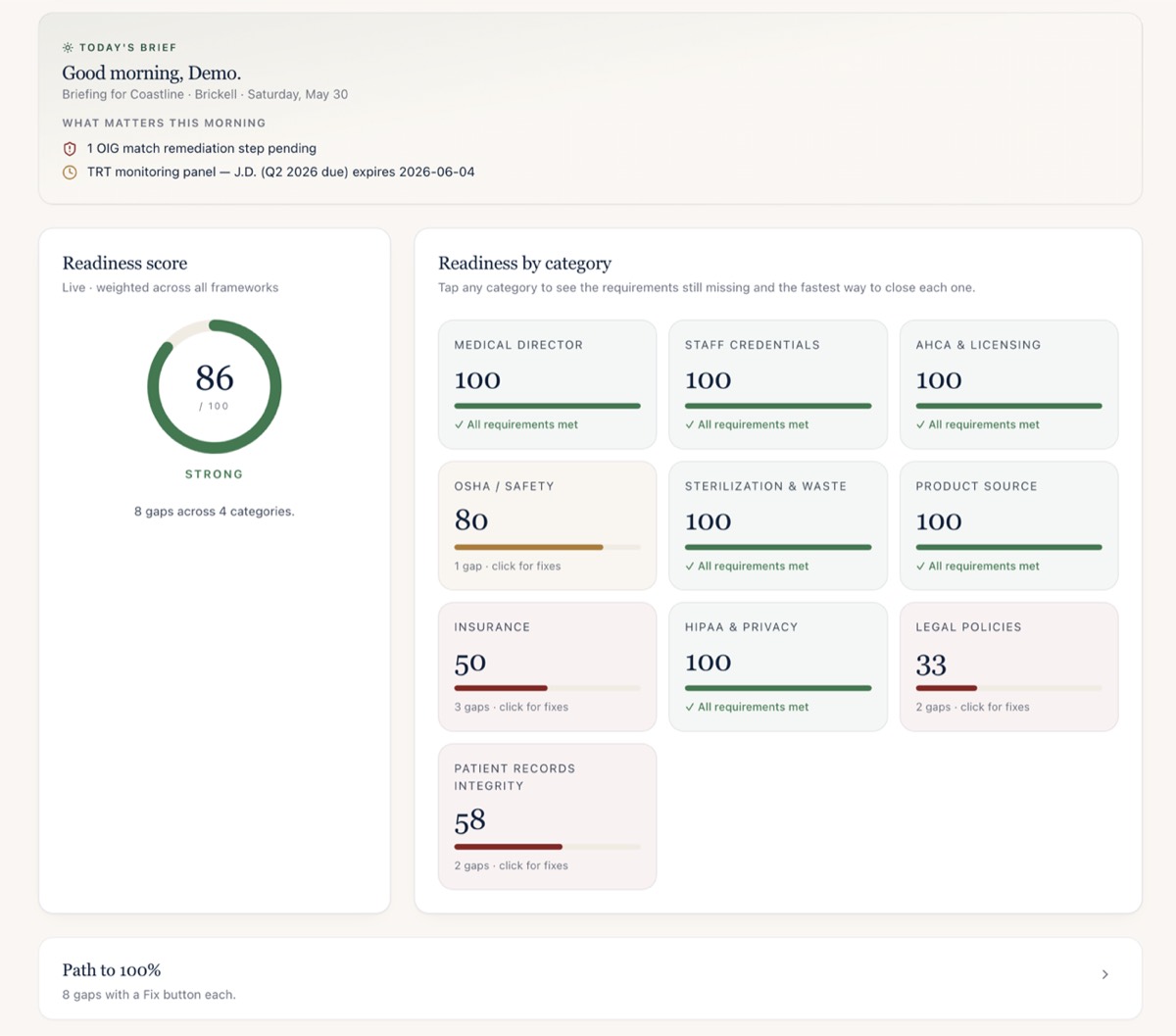
A single readiness number the owner and medical director can act on.
Your dashboard shows a daily readiness score, broken down by category — Medical Director, Staff
Credentials, Product Source, Waste & Sharps, Training, GFE evidence, Incident logs — calculated
from your actual document state, not a self-attestation. The score is internal to your team and your
insurance broker; it is not a medical-safety certification, public seal, or substitute for any
regulatory finding.
How it works
Set up in a week. Audit-ready in a month.
Compliance products fail because the migration is painful. We do the migration for you.
01
Discovery (day 0)
Twenty-minute call. We map your current vendors, EMR, training provider, medical director arrangement,
and where your existing proof lives.
02
Done-for-you migration (days 1–7)
We import your last twelve months of binders, set up the vendor inbox, connect Stericycle / MedPro / your
EMR, and onboard staff via SMS in their preferred language.
03
Live readiness (week 2 onward)
Agents run continuously. Gaps surface as SMS to the responsible staffer; unresolved items escalate to
the owner. Your readiness score updates daily.
04
Monthly readiness PDF (every 30 days)
On the 1st of every month, your branded readiness PDF lands in the owner's inbox.
Carriers appreciate organized documentation; inspectors and reviewers can see a clear evidence trail faster.
Why owners buy ProofOps
Built for four moments that create panic.
Patient complaint. Medical-director review. Insurance renewal. Inspection notice. ProofOps Medical
gives owners one place to find staff credentials, Good Faith Exam evidence, medical-director records,
product-sourcing proof, waste/sharps records, and missing-document follow-ups — before any of these
situations becomes urgent.
Moment 01
Patient complaint
Surface the treatment record, GFE evidence, consent, staff credentials, and product source for the
appointment in question — without a frantic email chain.
Moment 02
Medical-director review
Show delegation orders, standing protocols, supervision arrangement, and signed acknowledgments —
all dated and current — in one organized view.
Moment 03
Insurance renewal
Generate a single evidence pack with credentials, training proof, vendor records, incident summaries,
and 12 months of readiness scores — ready to send your broker.
Moment 04
Inspection notice
Run a documentation drill, get a gap report, and have role-specific scripts ready for your medical
director, RN, and front desk before the inspector arrives.
How we compare
Built for the spa, not the hospital.
You don't need MedTrainer's hospital LMS or Compliancy Group's eight-week onboarding.
You need the file ready before the next inspection — and someone who answers the phone.
Included
Not available
limited
Capability
ProofOps Medical
Us
Stericycle
Steri-Safe
Moxie
Compliance Defender
Generic SaaS
MedTrainer / similar
AI vendor inbox classifier
Included
—
—
—
Voice AI calling vendors
Included
—
—
—
Inspector-style documentation drill
Included
Human consultant
—
—
Good Faith Exam tracker (flags missing docs)
Included
—
Reminder only
—
Bilingual EN / ES staff workflows
Included
—
Limited
—
Insurance renewal pack (one click)
Included
Manual
Manual
Manual
Medical Director Evidence Vault
All plans
—
Limited templates
—
Private readiness dashboard (internal score)
Included
—
—
Private trust badge
Done-for-you migration
All plans
—
Coached
Self-serve
Works without changing your EMR
Yes
N/A
Moxie EMR only
Yes
Focus on Texas med-spa evidence workflow
Built for it
Adjacent
Adjacent
Adjacent
Focus
Built specifically for Texas med-spa evidence workflows.
Other tools listed are adjacent — built for hospitals, waste compliance, or general healthcare SaaS.
ProofOps
AI vendor inbox classifier— competitors
Voice AI calling vendors— competitors
Inspector-style documentation drill
Stericycle uses a human consultant
GFE tracker (flags missing docs)
Moxie reminds; doesn't block
Bilingual EN / ES staff workflows
Moxie has limited support
Insurance renewal pack (one click)
Everyone else: manual assembly
Medical Director Evidence VaultAll plans
Moxie offers limited templates only
Private readiness dashboard
Generic SaaS: private trust badges only
Done-for-you migration
Moxie: coached · Generic: self-serve
Works without changing your EMR
Moxie locks you to Moxie's EMR
Each row reflects the most-cited capability gap — based on publicly available product docs, May 2026.
Comparison reflects publicly available vendor information as of May 2026. Vendor names and trademarks are
property of their respective owners. "Limited," "Reminder only," and similar entries reflect feature
scope rather than absence.
Optional: Emergency Evidence Pack — $2,500 per incident
What the setup fee covers
A done-for-you migration. Not your front desk's problem.
The setup fee is a one-time charge that funds the people and engineering work to move twelve months
of paper, email threads, vendor portals, and spreadsheets into a clean digital file — and to wire your
real systems into ProofOps so the agents can do their job from day one.
●12-month binder import — for paper records, you just scan or photograph each page with your phone and send them to your proof@ inbox. Our AI agent does the rest: it uploads, classifies, tags, date-stamps, and files each one against manifests, training certs, SDS sheets, BAAs, and incident logs. No manual data entry. We send a one-page capture checklist at kickoff so the front desk knows what to send and the order to send it in.
●Vendor inbox setup — your dedicated proof@ address, with Stericycle / MedPro / training providers re-routed.
●Staff onboarding — each staffer enrolled by SMS in their preferred language with renewal dates loaded.
●License watcher seeding — TMB, BON, TDLR, DEA pulled and verified for every named clinician.
●Inspector simulator calibration — questions tuned to your specific scope of practice (Managed Evidence & up).
●Day-30 readiness PDF — your first branded report, hand-reviewed by us before it lands in your inbox.
Setup window:7 business days from kickoff.
Cancel anytime:No annual lock-in, no termination fees. Subscription ends at the close of the current billing cycle.
Setup credit:50% of the setup fee credited back to your account if you prepay 12 months upfront.
30
days
Risk reversal
30-Day Delivery Guarantee
If we miss any of the six measurable milestones below in your first 30 days, we refund your
setup fee plus your first month's subscription. No investigation, no fine print.
The six things we promise to deliver
01Migration completed within 7 business days of kickoff.
02Vendor inbox live with at least one auto-classified document filed.
03EMR integration connected and reading your schedules (Managed Evidence & up).
04Agents reaching at least 80% of your enrolled staff via SMS.
05First branded readiness PDF delivered by day 30 with a calculated score.
06Any reported P1 issue (an agent fails to perform a contracted action) resolved within 7 days.
What we need from you — within 7 days of signup
The guarantee depends on you supplying these items on time so the integration can go as planned.
The 30-day clock for any affected milestone pauses while we're waiting on a Customer-supplied item.
›Signed MSA, BAA, and order form
›Designated Account Owner with authority to act
›Staff roster — names, roles, license numbers, mobile, language preference
›Medical director details & supervision arrangement
›EMR admin approval / API key for our integration
›Waste vendor & training provider account info
›Email & vendor portal forwarding access for digital records
›Captured paper records (scan or phone photo)
›Existing ECP, BBP plan, OSHA logs, BAAs on file
›Insurance carrier & broker contact for renewal pack
›Procedure list & scope of services for inspector calibration
›Logo & brand assets if you want a branded readiness PDF
You hold up your end — supply the items above on time, approve the integrations, report issues within 7 days —
and we hold up ours. A milestone whose timing depends on a Customer-supplied item that arrived late
is excluded from the guarantee. Otherwise, you walk away with everything paid back.
See full terms in the FAQ →
All prices in USD. One location per subscription. Multi-location pricing on request. Setup fee billed at signup; subscription billed monthly thereafter unless paid annually.
Free Texas documentation audit
Tell us about your clinic. We'll send the audit in 24 hours.
Includes §169.25, HB 3749, OSHA 1910.1030, and evidence-workflow review.
We'll review what's publicly visible (your site, Google Business Profile, IV menu, team page) plus a brief
intake on your medical director arrangement, GFE workflow, and waste vendor. You get a one-page PDF
with the documentation gaps a Texas Medical Board inspector or insurance underwriter would surface today.
● 20-min intake · PDF in 24 hours● No card, no obligation, no upsell● Yours to keep either way
Audit request received.
Within one business day, you'll receive a 2-page PDF that includes:
● A scan of your public footprint against the 12 §169.25 / HB 3749 / HIPAA / FTC checkpoints Texas inspectors and underwriters look for.
● Your readiness score (0–100) with a clear rubric.
● Your top 5 prioritized fixes, with effort estimates.
● A clear note on what we did not cover — this is a documentation scan, not a clinical or legal review.
We'll email it from info@proofopsmedical.com. If you don't see it within 24 business hours, check spam — and feel free to reply directly to that thread.
Frequently asked
Questions Texas owners ask us.
What if ProofOps doesn't deliver in the first 30 days?+
That's exactly what the 30-Day Delivery Guarantee is for. If we miss any of the six
measurable milestones below by day 30 of your subscription — for reasons within our control — we refund
your setup fee plus your first month's subscription. No investigation, no fine print.
Migration completed within 7 business days of kickoff (all customer-supplied compliance records imported, classified, tagged).
Your dedicated vendor inbox is forwarding mail and has auto-classified at least one vendor document.
EMR integration is connected and successfully reading your patient schedules (Managed Evidence and White Glove plans).
Agents are running and SMS-reaching at least 80% of your enrolled staff.
First branded readiness PDF delivered to the Account Owner by day 30, with a calculated readiness score.
Any P1 issue you report (an agent that failed to perform a contracted action) is resolved within 7 days.
The guarantee is a partnership. To keep our 30-day promise, we need you to supply the following items
within 7 days of signup so integration can go as planned:
Signed MSA, BAA, and order form
Designated Account Owner with authority to act
Staff roster — names, roles, license numbers, mobile, language preference
Medical director details and supervision arrangement
EMR admin approval or API key for the integration
Waste vendor and training provider account info
Email and vendor portal forwarding access for digital records
Captured paper records (scan or phone photo) sent to your proof@ inbox
Existing ECP, BBP plan, OSHA 300 logs, BAAs on file
Insurance carrier and broker contact for the renewal pack
Procedure list and scope of services for the documentation-drill calibration
Logo and brand assets if you want a branded readiness PDF
The 30-day clock for any affected milestone pauses while we're waiting on a Customer-supplied
item. Once you've supplied everything we asked for, the clock resumes. If a milestone slips because of
something you didn't supply on time (for example, you didn't approve the EMR connection or didn't send
captured paper records), that milestone is excluded from the guarantee. Otherwise, if we miss any of the
six milestones for reasons within our control, you walk away with the setup fee and first month back.
Do we have to scan our paper files? How does the document capture work?+
Capture is on the clinic — but it's not the data-entry slog you might be picturing.
You don't sit at a scanner all day, and you don't manually upload anything one-by-one.
For paper records, the front desk simply scans the page on your existing printer or
snaps a phone photo, then forwards it to your dedicated proof@yourclinic.com
inbox (or attaches it to a quick text message). Our AI agent picks it up from there:
uploads it to your secure binder, classifies it (manifest / training cert / SDS / BAA / incident log /
GFE record / etc.), extracts the date, vendor, license number, and expiry, files it against the right
tag, and updates your readiness score. No manual data entry, no manual filing.
For digital records — anything already in email, vendor portals, EMR exports, or shared drives — we
handle the import for you during the 7-day migration window. You forward the relevant inboxes and
grant access; the agent does the migration.
We send a one-page capture checklist at kickoff that lists what to send and the order to send it in,
so a single afternoon of front-desk work gets the bulk of your 12-month history into the binder.
Do you replace our medical director, OSHA consultant, or attorney?+
No, and we won't pretend to. Your medical director sets clinical policy and signs delegation orders.
Your OSHA consultant validates your exposure-control plan. Your attorney advises on TMB responses.
ProofOps is the operational layer that proves their work was actually performed and stored — and that
your day-to-day staff workflows didn't drop the ball.
We already use Stericycle (or MedPro). Why pay you?+
Stericycle's portal stores manifests well. It does not chase missing receipts, run a §169.25 inspector
simulation, watch your EMR for missing GFEs, poll the Texas Medical Board for license renewals, or
generate a one-click insurance pack. Their guarantee covers OSHA bloodborne-pathogens citations only —
ours covers HIPAA, TMB, BON, and state aesthetic-board documentation gaps that theirs explicitly excludes.
Use both. They complement.
Which EMRs do you connect to?+
Aesthetic Record, Boulevard, Symplast, PatientNow, Nextech, and Mangomint at launch. If you use a different
EMR, we connect via report exports until a native integration ships. Unlike Moxie, ProofOps does not
require you to switch your practice-management system — we work alongside whatever you already run.
Is our patient data safe?+
ProofOps offers HIPAA-ready onboarding — we sign a Business Associate Agreement with every customer before any PHI
touches our system. Documents are stored encrypted at rest and in transit. We do not train AI models
on your data. Access is least-privilege by design and fully audit-logged. Detailed security documentation
is available on request.
How long to set up — and why is there a setup fee?+
We run a one-hour discovery call, then complete migration within seven business days. Most clinics
receive their first full readiness PDF on day 30. The setup fee ($999 / $2,500 / $4,999 depending on
plan) covers the actual labor of moving twelve months of paper, email threads, vendor portals, and
spreadsheets into your digital binder — plus EMR integration, voice-agent configuration, and staff
onboarding in both languages. Pay annually upfront and we credit 50% of the setup fee back to your
account. Either way, the migration is done by us, not your front desk.
Can we cancel?+
Yes, any time. There's no annual lock-in and no termination fee — your subscription ends at the close
of the current billing cycle and you stop being billed. Setup fees and past monthly fees are not refundable
(the setup fee covers actual migration labor we perform upfront; the monthly fee covers the agents and
infrastructure that ran during the period). You keep an exportable copy of your data for 30 days after
cancellation.
Do you serve clinics outside Texas?+
We start with Texas because §169.25 and HB 3749 created an immediate compliance gap and we want to do
one state extremely well before expanding. Florida, California, Arizona, and Georgia are next on the
roadmap. If you operate in those states and want to be on the early-access list, mention it on the audit form.
“
CG
Founder & CEO
Casiani Gherlan
ProofOps Medical
Letter from the founder
From the founder
A note on why we're shipping this now.
The Wortham, Texas case last week is a tragedy that became a precedent. A patient died. Two operators
were charged with felonies. An entire industry of well-run clinics now operates under a presumption of
guilt unless documentation proves otherwise.
The truth is most med spas and IV clinics aren't reckless — they're under-tooled. Their compliance work
is real; the proof of it is scattered across paper binders, vendor portals, the front-desk inbox, the
owner's phone, three spreadsheets, and someone's Drive folder.
ProofOps Medical exists to close that gap. Not to lecture owners about regulations they already know.
Not to replace the medical directors and OSHA consultants who do the underlying work. To centralize
the proof, run the agents that chase the gaps, and stand behind the file we hand you with our own money.
If you run a Texas clinic, a 20-minute call costs you nothing. The Wortham headlines have already
changed what your insurer, your inspector, and your patients expect. We can help you meet that bar
before your next audit, not after.
Casiani Gherlan
Founder & CEO, ProofOps Medical
Built around the rules that matter
Aligned with the regulations Texas inspectors and insurance underwriters actually cite.
We keep our claims specific: ProofOps is built around the regulatory frameworks below and focused on
documentation workflows — so you know exactly which paperwork it produces.
TMB §169.25
Texas Medical Board
HB 3749
Jenifer's Law · 2025
OSHA 1910.1030
BBP Standard
HIPAA
Privacy & Security
FDA DSCSA
Drug Supply Chain
TX BON 224
Board of Nursing
Works alongside the tools you already use
Aesthetic Record
Boulevard
Symplast
PatientNow
Nextech
Mangomint
Stericycle
MedPro Disposal
Inspection-ready, on autopilot.
Get your free Texas documentation audit or talk to the founder. Either way,
you'll know within an hour whether ProofOps Medical is right for your clinic.
The Wortham case is the practical illustration of why Texas's new medical-spa rules exist — and a preview of what enforcement looks like when documentation and supervision live only on paper.
On April 28–29, 2026, Amber Johnson, owner of Luxe Med Spa in Wortham, Texas, and Dr. Michael Patrick Gallagher, the spa's former medical director, surrendered to authorities to face a combined 39 felony charges related to the 2023 death of patient Jenifer Cleveland during an IV hydration session. Johnson faces 14 charges. Gallagher faces 25.
The criminal case is the first major prosecution against a non-clinician-owned IV practice under the framework Texas reorganized in 2025. According to court filings and reporting from KCEN, Dr. Gallagher — the named medical director on the spa's regulatory paperwork — was approximately 100 miles away at the time of Cleveland's IV infusion. Johnson, a phlebotomist, did not hold a Texas license to administer IV therapy. The supervision and delegation paperwork that should have governed the procedure either did not exist or was not being followed.
Inside the Texas medical-aesthetics community, the Wortham case is widely cited as the catalyst for HB 3749 ("Jenifer's Law"), which took effect September 1, 2025 and now restricts IV initiation to MD, APRN, PA, or RN providers under a documented physician-supervision arrangement. The arrests last week are the first major criminal action under that new posture.
Why this matters for every Texas med spa and IV clinic. The felony exposure traces directly to documentation. The medical director was named on paper. The supervision was not happening in practice. The gap between the two is what the prosecution is built on. Spas that operate the same way today face the same exposure tomorrow — not someday, this quarter.
The questions a Texas Medical Board investigator (and, increasingly, a District Attorney) will ask on the first day of an inquiry are now well-rehearsed: Show me your medical director's signed delegation orders. Show me the standing order for this procedure, dated and reviewed. Show me the supervision log for the last 30 days. Show me the Good Faith Exam that authorized the patient on the schedule today. If those records cannot be produced — clean, dated, and in writing — the gap is the case.
Federal enforcement against independent aesthetic practices used to be a theoretical risk. As of April 1, 2026, it is a public, named, indexed event — and the bar is documentation, not adverse outcomes.
On April 1, 2026, the U.S. Food and Drug Administration issued its first-ever DSCSA warning letter to a dispenser-tier facility — Pure Indulgence Aesthetics in Southlake, Texas. The Drug Supply Chain Security Act (DSCSA) governs the chain-of-custody documentation that must accompany any prescription drug as it moves from manufacturer to wholesaler to dispenser. The letter cited unit-count discrepancies in the practice's Botox records and inadequate documentation of receipt, transfer, and storage transactions for federally controlled aesthetic injectables.
For the medical-aesthetics industry, this is a watershed. DSCSA enforcement has historically focused on wholesalers, distributors, and large healthcare systems. Targeting an independent med spa — and doing so over documentation, not patient injury — signals that small aesthetic practices are now squarely on FDA's radar.
The warning letter is also a brand event. Federal warning letters are public, indexed by FDA, and routinely surface in patient web searches and insurance underwriting reviews. A single letter can affect renewal pricing for years and triggers patient questions ("Why is your name on the FDA's website?") that no amount of marketing can outrun.
What every Texas med spa needs to be able to produce on inspection. Unit-by-unit transaction records for every DSCSA-covered product (Botox, Dysport, Xeomin, Daxxify, dermal fillers, certain biologics) — including: who you bought it from (T2/T3 trading partner), the lot and serial number, the date received, the storage location, the patient or chart number it was used on, and the date administered. "We probably have it somewhere" is not the answer.
Practices that buy through reputable suppliers usually receive the chain-of-custody records they need. The compliance gap is almost always on the dispenser side — the records sit in someone's email, a vendor portal, or a paper binder, and nobody reconciles them against actual usage. A single missing line item is enough to support a finding.
21 USC § 360eee et seq. — Drug Supply Chain Security Act
When state regulators decide to act on documentation, they don't wait for a patient injury. New York's 2024 sweep is the modern enforcement playbook — and Texas's legal framework is already in place to run the same one.
Between June and September 2024, the New York City Council convened an interagency working group to address the rapid growth of unregulated medical-aesthetics practices. The working group brought together the New York State Department of Health, the State Education Department, and the Office of Professional Discipline to coordinate enforcement.
By September 2024, four NYC med spas had their licenses revoked. Eleven additional investigations were ongoing as of the Council's December 2025 progress report. Most striking: the most common findings were not patient injuries. They were documentation deficiencies — missing or vague delegation paperwork, unsigned protocols, undisclosed staffing, and unverifiable medical-director arrangements.
Why this matters for Texas. State-led enforcement playbooks travel. The NYC playbook — interagency coordination, documentation-first findings, public licensing actions — is the model state regulators across the country are studying. Texas, with the new TMB Chapter 169 rules and HB 3749 already in force, has the legal framework already in place. What is missing is the interagency execution, and industry observers including AmSpa and ByrdAdatto expect a similar enforcement push in Texas in 2026–2027.
The "we have a medical director" answer that historically passed in routine inspections is now considered insufficient under every modern enforcement playbook. What inspectors look for is the trail: who is the medical director, when did they sign the delegation order, when did they last review the protocols, where are the supervision logs, and is the staff member performing the procedure documented as a delegate. A spa that "has" a medical director but cannot produce that trail is no longer in compliance under either the New York or Texas regimes.
The reasonable response is not to acquire a different medical director. It is to make the documentation trail real, current, and producible — within minutes, not weeks — so the answer to the inspector's first question is, "Yes, here it is."
New York State Department of Health — public licensing action records (2024)
AmSpa — Industry coverage of the NYC interagency enforcement push
ByrdAdatto — Commentary on multi-state aesthetic-practice enforcement trends
The rule change that quietly redefined what "compliance" means for every Texas med spa, IV clinic, and aesthetic dermatology practice in 2025.
Effective January 9, 2025, the Texas Medical Board retired its prior delegation rule (§193.17) and replaced it with Chapter 169, sections §169.25 through §169.28. The new rules explicitly classify nonsurgical cosmetic procedures — Botox, dermal fillers, IV therapy, laser, microneedling, and similar — as the practice of medicine.
What changed in practice:
A documented Good Faith Exam (GFE), performed by a properly licensed clinician, is now required before any covered procedure. Generic patient-intake forms are not GFEs.
Written delegation orders for each delegated procedure must be on file, signed by the medical director, and tied to a named delegate.
Standing orders must be specific, dated, and reviewed periodically. Vague "the medical director approves" language no longer passes board scrutiny.
Each clinical staff member must wear ID with their full credentials clearly displayed during patient interactions.
Supervision logs for delegated procedures must be maintained.
The Texas Medical Board has stated explicitly that vague GFEs and standing orders do not meet the new standard. Inspectors are visiting practices across Texas and asking, on the first day of an investigation, to see the GFE record, the delegation order, and the supervision log for the procedures observed in the schedule.
The practical effect on the industry has been immediate. Practices that "have a medical director" but cannot produce these specific documents on inspection are operating outside the rule. The penalty is rarely the headline-grabbing fine — it is the inability to continue practicing the procedure until the documentation is corrected, board referral, license action against the medical director, and reputational impact in a market where patients now openly check public board-action records before booking.
The Wortham/Luxe Med Spa felony case in April 2026 is the practical illustration of what happens when the §169.25–169.28 paper trail is missing and a patient is harmed. The criminal exposure runs to the named medical director and the owner — not just to the staffer who held the syringe.
If your business model is "non-clinician-owned IV clinic," HB 3749 didn't end your business — it raised the documentation bar so high that paperwork is now the difference between operating and being shut down.
Effective September 1, 2025, Texas House Bill 3749 — known as Jenifer's Law in honor of Jenifer Cleveland — took effect. The bill restricts the initiation of any elective IV therapy in Texas to four provider categories: a physician (MD/DO), an advanced practice registered nurse (APRN), a physician assistant (PA), or a registered nurse (RN), all operating under a documented physician-supervision arrangement.
Practical implications for Texas IV hydration clinics, mobile IV businesses, and med spas that offer IV menus:
A non-clinician-owned business model is still legal, but the operations layer must include a properly licensed initiator under proper supervision for every infusion.
Written supervision protocols — including the supervising physician's identity, signed delegation orders, scope of practice, and review cadence — must be on file before each procedure, not after.
Phlebotomists, medical assistants, and aestheticians cannot initiate IV. They may continue to perform supportive tasks under direct supervision, but the initiation itself is reserved.
Concierge and mobile IV models face additional scrutiny because the clinical decision-maker is often physically absent — the documentation has to fill the gap.
The bill was prompted by the 2023 death of Jenifer Cleveland during an IV hydration session at Luxe Med Spa in Wortham, Texas. The criminal prosecution arising from that death — owner and ex-medical director surrendered on felony charges in late April 2026 — is the practical illustration of what HB 3749 is intended to prevent.
What inspectors and underwriters now ask for: the supervising physician's name and license number, signed delegation orders for every IV protocol on the menu, the supervision arrangement (in-person, telehealth, on-call) and the cadence at which standing orders are reviewed, and the IV-initiation log showing which licensed provider initiated which patient's infusion. Texas IV clinics that have not updated their delegation paperwork, supervision protocols, and provider rosters since September 1, 2025 are operating against the rule.
Documentation-only OSHA fines on small clinics are no longer rare. The same standard, the same paperwork, and the same penalty math apply across every state — including Texas.
In 2024, OSHA assessed a $14,502 civil penalty against a small medical practice in Naperville, Illinois (DuPage County) for inadequate documentation of bloodborne-pathogen training. The penalty was issued under 29 CFR 1910.1030 — the Bloodborne Pathogens Standard that applies to every Texas med spa, IV clinic, dental office, tattoo studio, and aesthetic practice that handles sharps or biohazard materials.
In the same enforcement window, DuPage County reported that twelve small practices were cited for missing or expired annual exposure-control-plan reviews — another straightforward documentation finding under the same standard. None of these citations involved patient injury. They were paperwork findings.
Penalty math owners often underestimate. Serious BBP findings start at $16,550 per instance in 2026. Willful or repeated findings can reach $165,514 per instance. A single inspection that surfaces three documentation deficiencies — a missing ECP review, an undated training log, and an incomplete sharps log — can produce a five-figure exposure on a single visit, regardless of clinical performance.
Why "we have Stericycle" is not a complete answer. Medical-waste vendors like Stericycle and MedPro Disposal include a documentation toolkit with their pickup contracts, and Stericycle's Steri-Safe Platinum tier carries a "No Fine. No Fail" guarantee — but only for OSHA bloodborne-pathogens citations. It does not cover HIPAA, Texas Medical Board, Texas Board of Nursing, or state aesthetic-board citations. Most documentation findings against med spas in 2024–2026 fall outside the OSHA-only carve-out.
What an OSHA inspector typically asks for, in order: the current Exposure Control Plan and the date of last review (must be annual); the Bloodborne Pathogens training records for every clinical staff member, signed and dated; the sharps-container log; the post-exposure incident log (even if empty, the log must exist); the SDS sheets for any chemicals used in the practice; and PPE training records. A practice that cannot produce all six within an hour is rarely walking out without findings.
The Texas Department of Insurance, professional liability underwriters, and increasingly insurance brokers are aware of this enforcement pattern. Many carriers now ask, at renewal, for documentation evidence of the items above. Carriers that previously accepted attestation are moving to evidence-based renewal underwriting in 2026.
OSHA Inspection Detail database (DuPage County, IL — 2024)
Stericycle — Steri-Safe Platinum "No Fine. No Fail" OSHA Guarantee
Request — Managed Evidence
Tell us about your clinic.
We'll reply within one business day with next steps and a contract.
Cookies on this site
We use a small number of essential cookies to run this site and a privacy-respecting analytics tool to count visits in aggregate.
We don't use cross-site advertising trackers and we don't sell personal information. See our Privacy Policy.